Co-Founding a Campus Event & Ticketing Platform
Co-founded a campus organisation event and ticketing platform, owned requirements from idea to public launch with 600+ registered users, and learned first-hand why it stalled after MVP.
It didn't start with a brief. It started with a complaint we all shared.
We were students running campus organisations, and the administrative side was exhausting in a specific, repetitive way: attendance taken by hand, event payments collected through Google Forms, member communication scattered across chat groups, and the data you needed to make any decision sitting in four places at once.
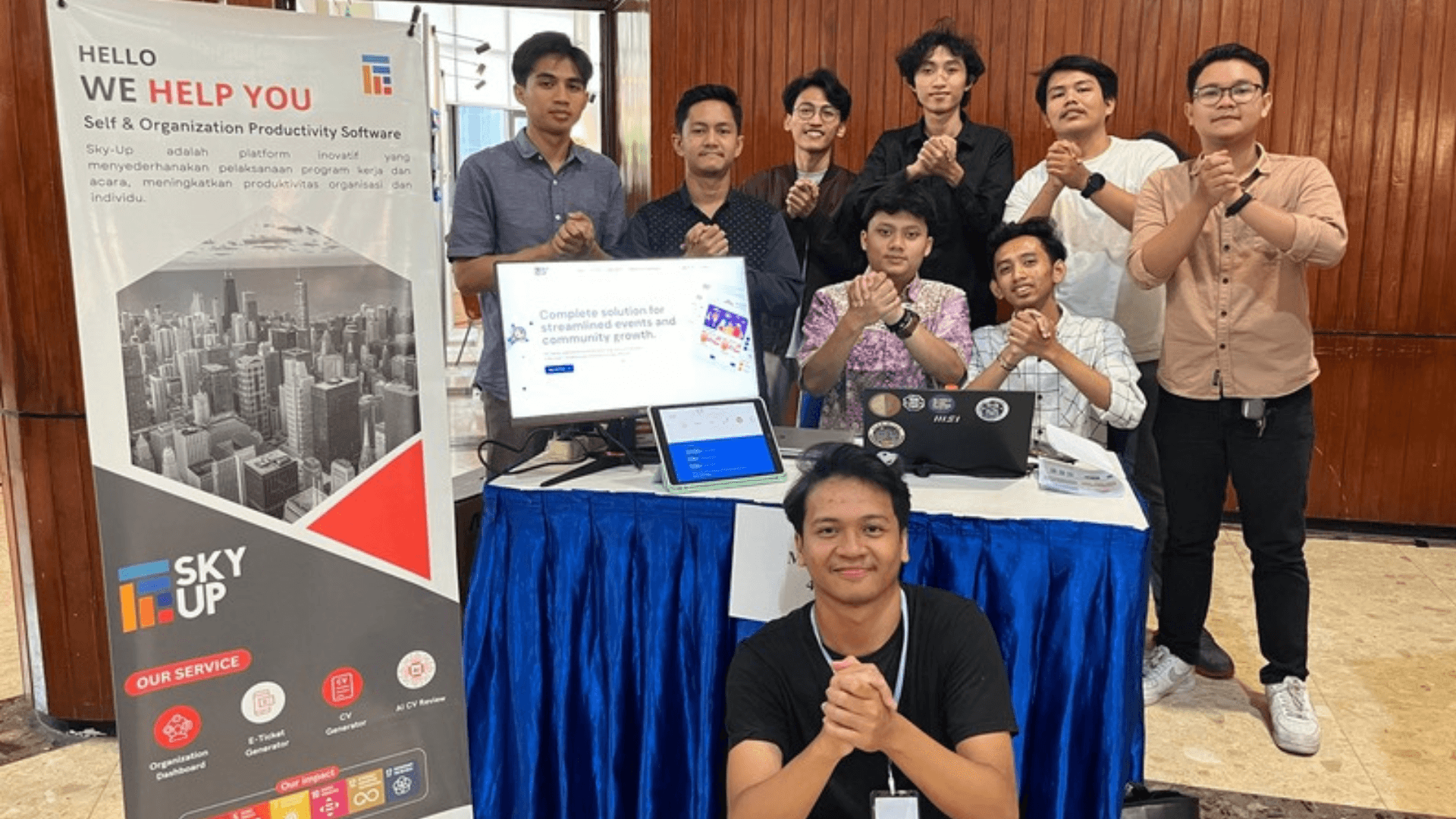
Sky-Up Synergy was built as the single system for that — event and ticketing, organisation management, activity and attendance tracking, member performance, and financial withdrawal for organisation treasuries. It received funding through Brawijaya Startup Action.
My position in the founding team mattered. I was the first person to join with an IT background; the other founders came from business. That meant I wasn't handed a technical team to run — I had to work out what roles we needed, recruit them, and then lead them: four developers and one UI/UX designer, within a ten-person founding team. Backend in Golang, frontend in React and Next.js, design in Figma.
Find the general shape underneath a specific request, then make the stakeholder prefer it.
A public launch, 600+ users — and a failure I turned into published research.
The platform reached public launch with 600+ registered users and adoption by 10+ student organisations across several universities. Growth came from direct outreach and business partnerships run by our business team. What I got wrong — two things, and they compounded. We had no QA function and I didn't compensate for it. Release testing happened without proper scenario coverage, which meant quality control at the end of the pipeline was weaker than the specification work at the front of it. Writing good requirements and not verifying against them is a strange way to fail, and it's the way I failed. Second, I absorbed too many small fixes requested by the business side. Individually each one took an afternoon. Collectively they beat the roadmap, fragmented the developers' focus, and produced exactly the context switching and technical debt that eventually stalled us after MVP. I didn't leave that as a regret. I made it the subject of my undergraduate thesis, built an AHP framework to solve the prioritisation failure specifically, and published it. Whether it was adopted after I left isn't something I control — I'd left the team by then. But the diagnosis was mine and so was the method. I left in July 2026, after my vision for the product and the CEO's had diverged and my closest collaborator had already gone.